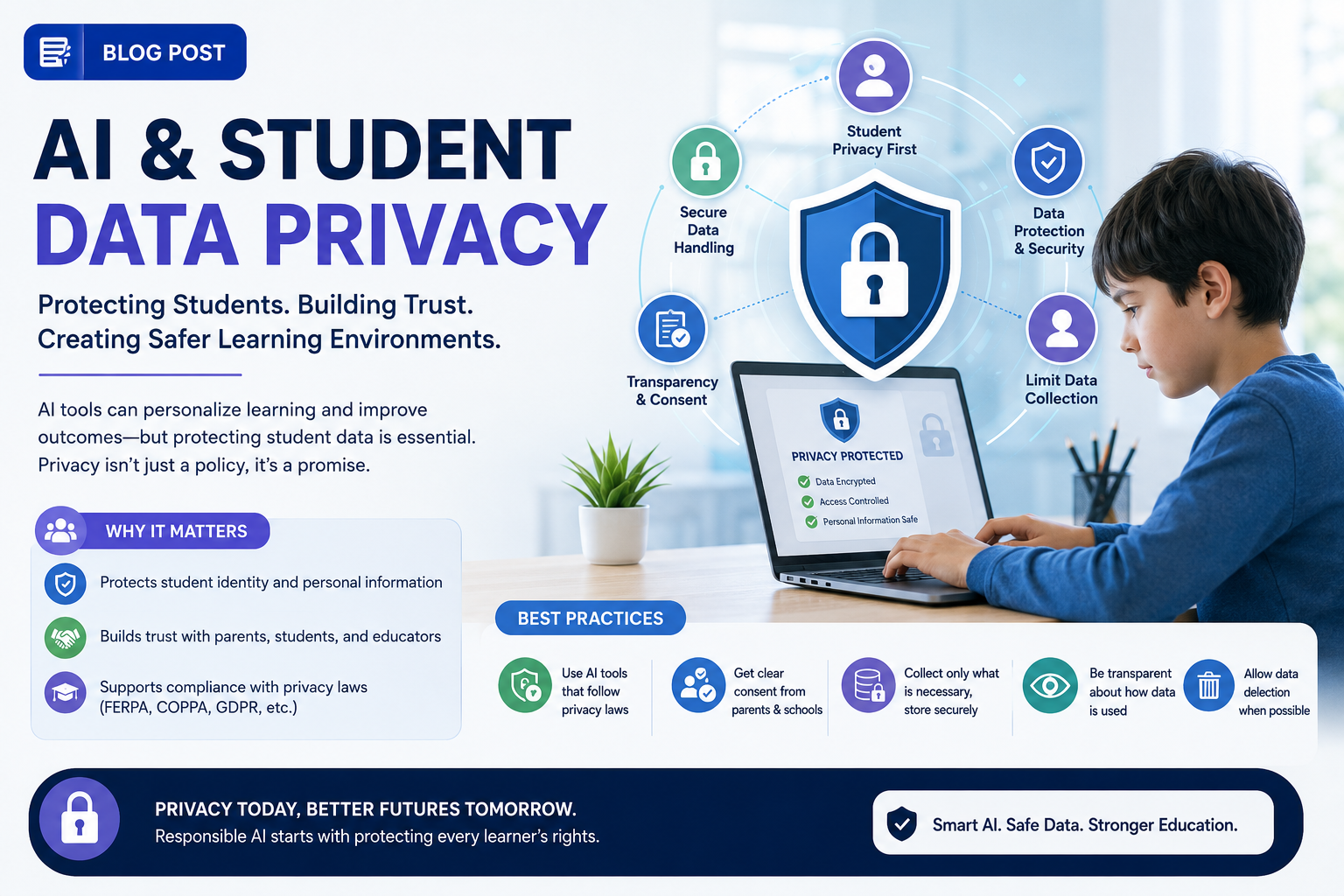
Every teacher I know has typed a student’s name into an AI tool at least once without thinking twice about it, and that’s exactly why ai student data privacy deserves a plain-language explanation instead of another wall of legal text. This guide breaks down what FERPA and COPPA actually require, how to check whether a specific tool is safe to use, and what to do before you paste any real student information into a chatbot.
A quick note before we start: this article explains general concepts in plain language and points you to official sources. It is not legal advice, and your district’s data privacy officer or legal counsel is the final word on what’s approved for your classroom.
Quick-Answer Box: The Core Rule
| Question | Short Answer |
| Does FERPA apply to AI tools? | Yes, when the tool touches education records |
| Does COPPA apply to AI tools? | Yes, for most tools students under 13 use directly |
| Can I paste a student’s name into ChatGPT? | Not unless your district has approved that specific use |
| Where do I check if a tool is vetted? | Your district’s approved tool list, and Common Sense Media’s Privacy Program |
| Who decides what’s approved? | Your district not you, and not the tool’s marketing page |
What FERPA Actually Covers
The Family Educational Rights and Privacy Act, or FERPA, protects the education records that schools maintain about students grades, disciplinary records, IEP information, and similar data. The law was written decades before generative AI existed, but the U.S. Department of Education’s Student Privacy Policy Office has made clear that FERPA’s existing rules still apply whenever an AI tool processes education records, not just when a human does.
Read more: AI Tools for Special Education
The part that trips teachers up most is the “school official” exception. A district can let an outside vendor, including an AI company, handle student data under this exception, but only if the district has formally designated the vendor as a school official, the vendor is under the district’s control regarding how it uses the data, and the vendor doesn’t pass that data along elsewhere without permission. In practice, this means a tool being “used in schools” doesn’t automatically mean your specific use of it is covered that depends on whether your district has actually set up that agreement.
FERPA Compliant AI Tools: What to Look For
When people search for ferpa compliant ai tools, they’re usually looking for a simple yes-or-no answer, and unfortunately there isn’t always one. Compliance isn’t just a feature the tool has it’s a relationship between the vendor’s contract terms and your district’s own policies.
That said, there are concrete things you can check before trusting a tool with real student information: does the vendor have a written data processing agreement with your district, does the privacy policy explicitly say student data won’t be used to train the underlying AI model, and is there a stated data retention and deletion timeline. If a tool’s privacy policy can’t answer these questions clearly, treat that as a warning sign rather than an oversight.
Read more: free AI tools teachers actually use
COPPA and AI in Schools
Coppa and ai in schools is a related but separate issue from FERPA. The Children’s Online Privacy Protection Act governs how online services collect personal information from children under 13, and it applies the moment a student interacts directly with a platform not just when a school stores a record about them afterward.
For schools, there’s a narrower path: a district can sometimes consent on a parent’s behalf for tools used strictly for school purposes, but that consent doesn’t extend to a vendor using student data for advertising or for purposes unrelated to education. If an AI tool’s business model depends on advertising, that’s a strong signal it needs closer scrutiny before any student under 13 uses it directly.
How I Check for Safe AI Tools for Students
Over the past year I’ve built a simple habit before introducing any new tool to my classroom, and it’s become my personal filter for safe ai tools for students.
First, I check whether the tool is already on my district’s approved list if it is, most of this work has already been done for me. If it isn’t, I look up the tool on Common Sense Media’s Privacy Program, which independently evaluates edtech privacy policies against a detailed rubric and publishes the results for free. I also read the tool’s own privacy policy for one specific line: whether student inputs are used to train the company’s models. If that’s unclear or answered vaguely, I don’t use the tool with real student names, even if it’s popular.
Read more: MagicSchool’s approach to student data
Student Privacy EdTech: The Questions Worth Asking a Vendor
If you’re in a position to evaluate student privacy edtech for your school or department, a short list of direct questions goes further than reading an entire privacy policy end to end:
- Does the tool store student data, and for how long?
- Is student data used to train the underlying AI model?
- Does the vendor have a signed data processing agreement with the district?
- What happens to student data if the district stops using the tool?
Vendors who answer these clearly and specifically are generally further along in their compliance work than vendors who respond with vague reassurance.
Read more: Will AI Replace Teachers
Read more: grading essays with AI
School Data Protection Starts With Habits, Not Just Policy
School data protection isn’t only a district-level responsibility a lot of it comes down to everyday habits in individual classrooms. The simplest one: never paste a student’s full name, ID number,or identifiable details into a general-purpose AI tool unless your district has explicitly cleared that specific use. Anonymizing student work before using AI to help grade or analyze it removing names, using initials, or working with de-identified samples closes most of the everyday risk without waiting on a policy update.
Read more: academic honesty
Frequently Asked Questions
Does ai student data privacy law require parental consent for every AI tool? It depends on the tool and the age of the student. Districts can sometimes consent on a parent’s behalf for school-purpose tools, but this doesn’t cover every use case, especially advertising-supported platforms.
What are the clearest signs of ferpa compliant ai tools? A written data processing agreement with your district, a clear statement that student data isn’t used for AI model training, and a defined data retention and deletion policy.
How does coppa and ai in schools affect tools students use directly, like a chatbot? COPPA applies the moment a child under 13 interacts with an online service, which is a lower bar than FERPA’s focus on records a school maintains so a chatbot a student talks to directly can trigger COPPA even before any record is created.
Where can I check if a tool counts among safe ai tools for students? Start with your district’s approved tool list, then check Common Sense Media’s Privacy Program, which independently evaluates and publishes privacy ratings for edtech products.
Bottom Line
Ai student data privacy isn’t a single checkbox it’s an ongoing habit of checking before you trust, both at the classroom level and the district level. FERPA and COPPA give you the legal framework, but the day-to-day protection comes from asking the right questions before a tool ever sees a real student’s name.
Reviewed in July 2026 using publicly available guidance from the U.S. Department of Education’s Student Privacy Policy Office and Common Sense Media’s Privacy Program. This is not legal advice check with your district’s data privacy officer before adopting any new tool. I’ll update this post as guidance changes; reach out with questions.
Disclosure: Some links on this site may be affiliate links, which help support this blog at no extra cost to you.
Read more: ai workflow for teachers