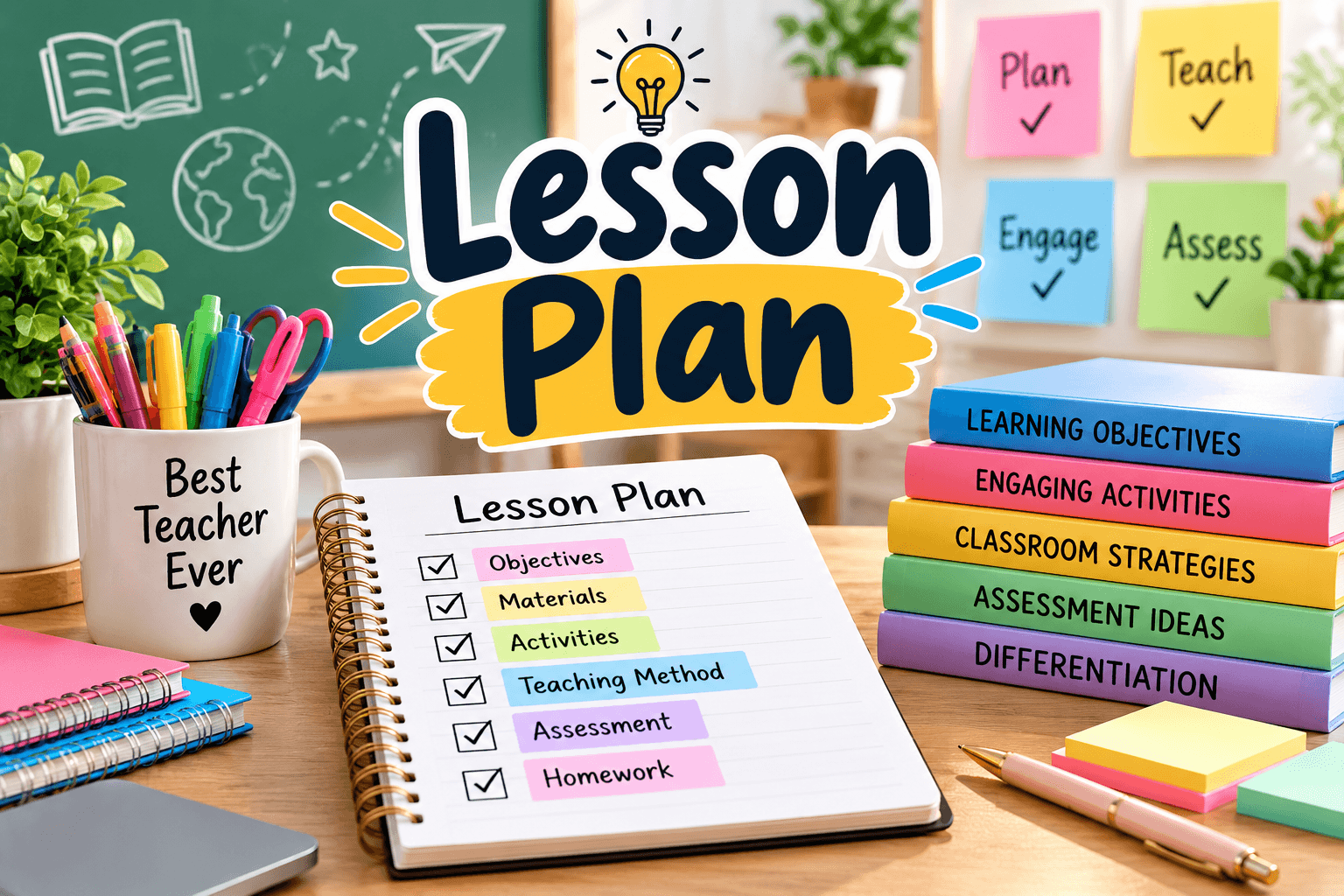
It’s the night before a big teaching day. You have a topic, a stack of materials, and a vague idea of how the hour will unfold. Then class begins, an activity runs long, a student’s question sends the discussion sideways, and the main goal never gets covered. Sound familiar? A well-built lesson plan is the fix. It turns a loose idea into a clear roadmap so every minute has a purpose.
In this guide, you’ll learn what this document is, why it matters, what it should include, how to write one from scratch, and which mistakes to avoid. Everything here works for any subject or grade level, from kindergarten story time to university seminars.
What Is a Lesson Plan?
It is a teacher’s detailed guide for a single class session. It describes what students will learn, how the material will be taught, which activities and resources will be used, and how understanding will be checked. Think of it as a map: it shows the destination, the route, and the checkpoints along the way.
Formats vary widely. Some teachers write multi-page documents with every prompt scripted, while others use a one-page outline or a simple table. The format matters less than the clarity. A good one lets a colleague or substitute teacher pick it up and know exactly what should happen in class.
Why a Strong Lesson Plan Matters
Classroom time is limited, and careful preparation protects it. Here’s what thoughtful planning does for you and your students:
Keeps instruction focused. When you know the goal, it’s easier to cut side activities that don’t serve it.
Improves pacing. Estimating time for each segment helps you avoid rushing the ending or dragging the beginning.
Supports differentiation. Planning ahead lets you prepare extra support for students who struggle and extensions for those who finish early.
Makes assessment purposeful. Deciding how you’ll check understanding before the lesson keeps your questions and tasks aligned with the objective.
Reduces stress. Walking into class prepared gives you confidence and mental space to respond to students in the moment.
Enables reflection and reuse. A written record lets you improve a lesson year after year instead of starting over.
Core Components of a Lesson Plan
Most effective plans, regardless of format, contain the same building blocks:
Title and context. Include the subject, grade level, date, and lesson length so the plan is easy to find and understand.
Learning objectives. These are specific statements of what students will know or be able to do by the end. Strong objectives use measurable verbs such as explain, compare, solve, or create rather than vague ones like “understand.”
Standards or curriculum links. Note the standards or outcomes the lesson supports.
Materials and resources. List texts, handouts, technology, and supplies so nothing is forgotten.
Opening activity. A short warm-up, question, or problem activates prior knowledge and captures attention.
Main instruction. This is where you introduce or model the new concept through explanation, demonstration, or discussion.
Practice. Students apply the skill, first with guidance and then more independently.
Assessment. This can be an exit ticket, a quick quiz, observation notes, or a short written response.
Closure. Summarize key ideas and connect them to what comes next.
Differentiation and notes. Record accommodations, grouping plans, and reminders for yourself.
How to Write a Lesson Plan Step by Step
If you’re staring at a blank page, follow this sequence.
Step 1: Start with the end goal
Ask yourself what students should be able to do by the end of class. Write one to three clear objectives. If you can’t describe the goal in a sentence, the lesson isn’t ready to be planned.
Step 2: Decide how you’ll measure success
Before choosing activities, decide what evidence will show that students reached the goal. This might be a solved problem set, a short paragraph, or a verbal explanation. Working backward this way keeps the whole lesson aligned.
Step 3: Consider your learners
Think about what students already know, what misconceptions are likely, and what support certain learners will need. A lesson that ignores the starting point of your class rarely lands well.
Step 4: Choose your teaching approach
Select strategies that match the objective. Modeling works well for procedures, discussion suits open-ended ideas, and hands-on investigation fits scientific concepts. Vary the methods so students aren’t sitting through one long lecture.
Step 5: Sequence the activities and set times
Arrange the lesson into segments, such as a five-minute opener, a fifteen-minute mini-lesson, twenty minutes of practice, and a five-minute closer. Add a small time buffer, because transitions almost always take longer than expected.
Step 6: Prepare materials and questions
Gather resources, prepare handouts, and write down the key questions you’ll ask. Planning good questions ahead of time is one of the most effective ways to deepen thinking.
Step 7: Review and rehearse
Read your lesson plan aloud or walk through it mentally. Look for confusing instructions, unrealistic timing, or missing materials. Fixing problems on paper is much easier than fixing them in front of thirty students.
Popular Lesson Structures to Try
You don’t need to invent a structure from nothing. Several well-known models can guide your design:
Direct instruction. You explain and model, students practice with support, and then they work independently. It’s efficient for teaching clear, step-by-step skills.
The 5E model. Popular in science, it moves through Engage, Explore, Explain, Elaborate, and Evaluate, giving students time to investigate before formal explanations.
Gradual release of responsibility. Often summarized as “I do, we do, you do,” it slowly shifts the work from teacher to student.
Backward design. Introduced in the Understanding by Design framework, it begins with desired results, then assessment evidence, and finally learning activities.
Try one model at a time, and adapt it to your students rather than following it rigidly.
Common Mistakes to Avoid
Even experienced teachers stumble on a few predictable issues.
Overpacking the session. An overloaded lesson plan leaves no room for questions, mistakes, or the discussions that make learning stick. It’s better to teach one idea well than to rush through four.
Writing vague objectives. “Students will learn about fractions” doesn’t tell you what to teach or assess. “Students will compare two fractions with unlike denominators” does.
Forgetting to plan transitions. Handing out papers, moving desks, and switching activities all take time. Build them into your schedule.
Focusing only on what the teacher does. Plan what students will be doing, thinking, and producing, not just what you’ll say.
Skipping assessment. Without a check for understanding, you won’t know whether to move on or reteach.
Refusing to adjust. A plan is a guide, not a contract. If students need more time, adapt. Note what changed so you can improve the plan later.
Frequently Asked Questions
How long should one be?
Long enough to guide you, and short enough that you’ll actually use it. Many teachers find a single page sufficient. Beginners often benefit from more detail, while veterans may need only key points.
Do experienced teachers still write them down?
Many do, though often in a shortened form. Writing forces clear thinking, and it creates a record that saves time in future years.
How do I plan for students at different levels?
Build in choices and layers, such as tiered tasks, sentence starters, extension challenges, and flexible grouping. Decide these supports in advance rather than improvising.
What should I do when a lesson doesn’t go as planned?
Reflect briefly afterward. Note what worked, what confused students, and what you’d change. Those notes are valuable when you teach the topic again.
Final Thoughts
Strong teaching rarely happens by accident. It grows from clear goals, thoughtful sequencing, and a willingness to adjust when real students respond in unexpected ways. The habit of planning ahead gives you structure without taking away your creativity.
For your next lesson plan, start small. Write one measurable objective, decide how you’ll check for it, and map out three simple segments. As the process becomes familiar, you’ll find that planning gets faster, your classes run more smoothly, and your students benefit from lessons that feel purposeful from the first minute to the last.