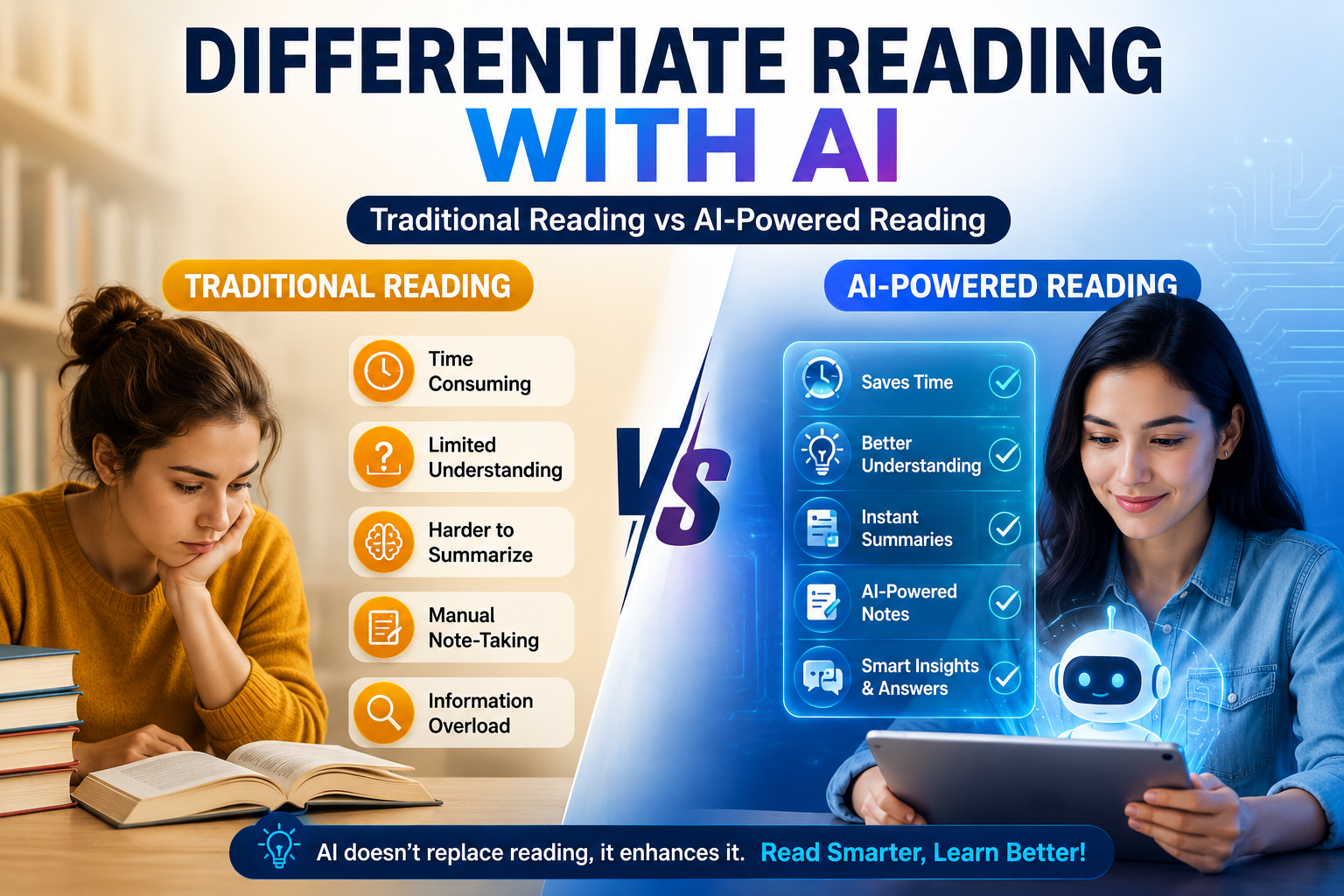
Every classroom is a mix of readers. On any given day, a teacher might have students reading three, four, even five grade levels apart all sitting in the same room, expected to engage with the same lesson. For decades, teachers solved this problem the hard way: manually rewriting passages, hunting for leveled texts, or simply handing everyone the same worksheet and hoping for the best.
That’s changing fast. Today, teachers can differentiate reading with AI in minutes instead of hours. Artificial intelligence tools can take a single article, story, or textbook excerpt and instantly generate versions suited to different reading levels without stripping out the core content or dumbing down the ideas. This post walks through exactly how that works, which tools to use, and how to build differentiated reading into your everyday teaching routine.
Why Differentiating Reading Materials Still Matters
Reading differentiation isn’t a new idea, it’s one of the oldest challenges in education. But it’s also one of the most persistently under-resourced. Teachers routinely report spending hours each week rewriting or searching for texts that match the range of readers in front of them.
The stakes are real. A student reading two grade levels below their peers doesn’t just miss vocabulary they miss confidence, engagement, and eventually motivation. On the other end, advanced readers handed material that’s too easy to disengage just as quickly. Getting the reading level right isn’t a nicety; it’s often the difference between a student who participates and one who checks out.
This is where a good reading level adjustment tool changes the math entirely. Instead of choosing between “one text for everyone” and “hours of manual rewriting,” teachers can generate multiple versions of the same content automatically.
How AI Actually Adjusts Reading Levels
AI language models are trained on enormous amounts of text across every reading level to differentiate reading with AI imaginable from picture books to academic journals. That means they can recognize patterns like sentence length, vocabulary complexity, syntax structures, and paragraph density, then rewrite content to match a target level while preserving meaning.
When you ask an AI tool to simplify or elevate a passage, it typically adjusts:
- Vocabulary swapping complex or academic words for age-appropriate synonyms (or vice versa for advanced readers)
- Sentence structure breaking long, compound sentences into shorter ones, or combining short sentences for more advanced readers
- Text length trimming or expanding explanations depending on the target audience
- Contextual scaffolding adding definitions, examples, or background information for struggling readers
The result is a set of texts that all cover the same topic and key ideas, just delivered at different levels of complexity. This is the foundation of any good leveled text generator with the same content, multiple entry points.
Popular AI Tools for Differentiated Reading
Several platforms have built entire products around this exact use case. Here’s a quick look at what’s out there.
Diffit
Diffit is probably the most well-known tool built specifically for this purpose. Teachers paste in a topic, URL, or their own text, and Diffit generates reading passages at multiple levels, along with vocabulary lists, comprehension questions, and even graphic organizers.
A basic Diffit tutorial looks like this:
- Go to the Diffit website and create a free teacher account
- Choose whether you want to generate content from a topic, a pasted text, or a URL
- Select the grade levels you need (Diffit can generate several at once)
- Review the generated passages, vocabulary, and questions
- Export or share directly with students through Google Classroom or a PDF
The biggest advantage here is speed. What used to take an evening of rewriting now takes about five minutes.
General-Purpose AI Chat Tools
Tools like Claude or ChatGPT can also Differentiate reading with AI materials, even though they weren’t built exclusively for education. You simply paste in your text and ask for a rewritten version at a specific level. For example:
“Rewrite this passage about the water cycle for a 3rd-grade reading level. Keep the key facts but simplify vocabulary and shorten sentences.”
The advantage of general AI chat tools is flexibility: you can ask for very specific adjustments (a particular Lexile band, a specific dialect, a particular tone) that dedicated apps may not offer. The trade-off is that you have to write your own prompts and manually check accuracy each time.
Newsela and Similar Platforms
Newsela was one of the earlier platforms to popularize the concept of the same news article rewritten at five different reading levels. While not purely AI-generated in its original form, many of these platforms now use AI to expand their libraries and speed up content adaptation.
Building Reading Comprehension by Level
Generating a leveled text is only half the job. The other half is making sure comprehension actually happens at each level. This is where reading comprehension by level becomes its own skill for teachers to plan around.
A few practical guidelines:
- Match questions to the text, not just the topic. A struggling reader’s comprehension questions should check understanding of the simplified vocabulary and sentence structure they were given, not the advanced version another student received.
- Layer in higher-order thinking at every level. Simplifying vocabulary doesn’t mean simplifying thinking. Even a below-level text can pair with an inference or analysis question.
- Use consistent question stems across levels. If every version of the text has a “main idea” question and a “supporting detail” question, you can still run a whole-class discussion where every student contributes, regardless of which version they read.
- Check for text fidelity. AI-generated simplifications occasionally drop or alter details. Always skim the output before handing it to students, especially for factual or historical content.
Mixed Ability Classroom Strategies That Use AI Well
Differentiated texts are most powerful when they’re built into a broader set of mixed ability classroom strategies, not used as a one-off fix. Here are a few ways teachers are weaving AI-generated reading materials into daily instruction.
1. Jigsaw Reading with Leveled Groups
Break students into small groups by reading level, each working with an AI-adjusted version of the same core text. Afterward, mix the groups so students share what they learned. Everyone contributes meaningfully because everyone actually understands their portion.
2. Choice Boards
Offer two or three AI-generated versions of a text and let students self-select which one they want to try first, with the option to move up or down. This builds reading confidence and autonomy while still keeping everyone on the same topic.
3. Scaffolded Read-Alouds
For whole-class read-alouds, use an AI-simplified version as a pre-reading warm-up for students who need it, so they walk into the full-class discussion already familiar with the vocabulary and main ideas.
4. Independent Practice Stations
Set up a rotation where one station includes AI-leveled passages matched to each student’s current reading data, refreshed weekly as reading levels shift throughout the year.
5. Vocabulary Pre-Teaching
Before assigning any leveled text, generate a short vocabulary list at the matching level using the same AI tool. Front-loading vocabulary reduces the cognitive load once students hit the actual passage.
A Simple Workflow to Get Started This Week
If you’re new to using AI for differentiation, here’s a low-lift way to try it out:
- Pick one text you already plan to teach this week
- Run it through an AI tool (Diffit, or a prompt to Claude or ChatGPT) and generate two additional versions one simpler, one more advanced
- Create matching comprehension questions for each version, using the same stems
- Assign versions based on recent reading data, not guesswork
- Debrief as a whole class using shared discussion questions
Repeat this for a few weeks, and you’ll start to build a personal library of leveled texts you can reuse and adapt each year.
Common Concerns, Addressed
Will this replace my judgment as a teacher? No. AI can generate a first draft of a leveled text in seconds, but you still decide what’s taught, how it’s scaffolded, and whether the output is accurate. Think of it as a very fast teaching assistant, not a replacement for your expertise.
Is the content accurate? Mostly, but not always. Always review AI-generated text before handing it to students, particularly for STEM or historical content where small wording changes can shift meaning.
Does this work for all subjects? It works especially well for informational text, current events, science explainers, and history anywhere content can be reworded without changing the underlying facts. It’s less reliable for poetry or literary analysis, where tone and word choice are the point.
Final Thoughts
AI has genuinely changed that equation. With the right reading level adjustment tool, a five-minute task can replace what used to be an hour of manual rewriting freeing up teacher time for the parts of the job that actually require a human: relationships, feedback, and judgment calls no algorithm can make.
Start small. Pick one text, generate a couple of leveled versions, and see how your students respond. Once you experience how much easier true differentiation becomes with AI, it’s hard to go back to the one-size-fits-all worksheet.