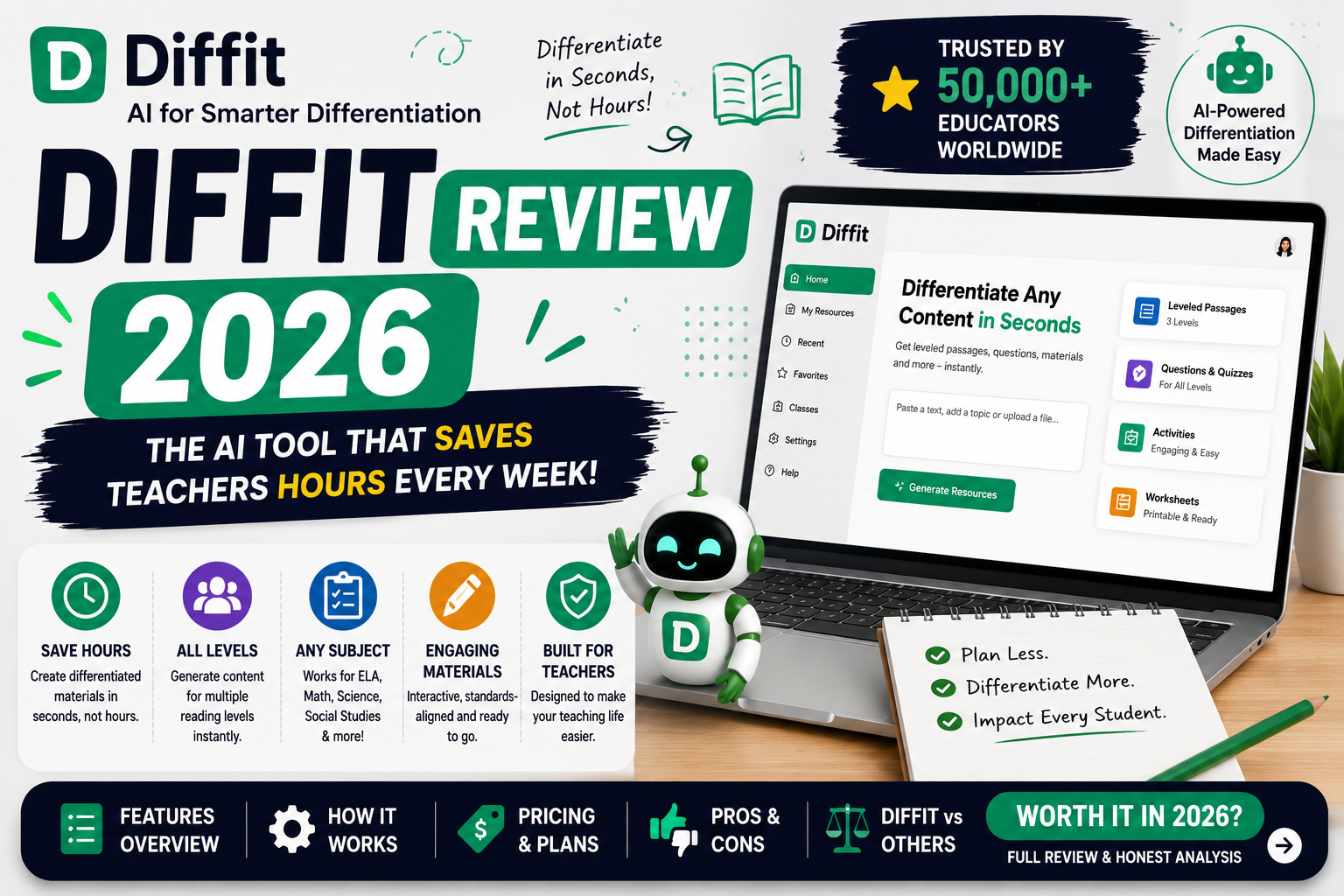
If you have ever spent a Sunday evening rewriting the same science article at three different reading levels for Monday’s mixed-ability class, you already understand the problem this tool was built to solve. In this Diffit review, we take a detailed, hands-on look at one of the most talked-about AI tools in K-12 education and answer the questions teachers ask most: What does it actually do? Is Diffit free? And is it genuinely better than the growing list of competitors?
By the end of this Diffit review, you will know exactly whether this reading level adapter deserves a permanent spot in your lesson-planning workflow or whether one of the Diffit alternatives might suit your classroom better.
What Is Diffit?
Diffit is an AI-powered platform designed specifically for educators. At its core, it takes any source material a typed topic, a pasted article, a PDF, a website URL, or even a YouTube video and instantly transforms it into differentiated reading passages written at multiple grade levels, roughly from 2nd grade through high school.
Alongside each adapted passage, Diffit for teachers automatically generates comprehension questions, vocabulary lists with student-friendly definitions, and short summaries. In other words, it produces a complete, ready-to-teach resource packet in under a minute work that would normally eat 30 to 60 minutes of prep time per lesson.
The tool has become especially popular with teachers of English language learners, inclusion classrooms, and any room where students read at widely different levels (which, let’s be honest, is every room).
Read more: is using ai cheating
How Diffitore Works: A Quick Walkthrough
The workflow looks like this:
Step 1 Choose your input. Type a topic (“the water cycle for 5th graders”), paste an existing text, drop in a URL, upload a PDF, or link a YouTube video.
Step 2 Pick a reading level. Select the grade level you want, and the reading level adapter rewrites the content accordingly. You can regenerate the same material at several levels, so your advanced readers and your struggling readers work with the same ideas at different complexity.
Step 3 Review the generated resources. Diffit produces the adapted passage plus multiple-choice questions, short-answer prompts, vocabulary cards, and a summary. Questions scale with the level a 3rd-grade version gets simpler recall questions, while an 8th-grade version pushes inference and analysis.
Step 4 Export and teach. Free users can download everything as a PDF, print it, or share it via link. Paid users unlock editable exports to Google Docs, Google Slides, and Microsoft Word.
The multilingual support deserves special mention. Diffit can translate materials into dozens of languages while keeping the scaffolds intact, which makes it a favorite among ESL and EAL teachers who need the same content accessible in a student’s home language.
Is Diffit Free? Pricing Explained
This is the question every teacher asks first, so let’s answer it clearly: yes, Diffit has a genuinely useful permanent free plan. On the free tier you can generate differentiated reading passages, questions, and vocabulary at any grade level, then download them as PDFs, print them, or share them by link with no hard usage cap on the core features.
The main limitation of the free plan is export format. If you want to edit the output tweak a question, reformat a worksheet to match your classroom template you will need the paid Individual Teacher plan, which costs $14.99 per month or $149.99 per year and adds Google Docs, Slides, and Word export.
There is also Diffit for Schools, a flat-rate annual site license tiered by student enrollment. It gives unlimited premium access to all staff and adds extras like standards alignment and Google Classroom integration. Schools need to contact Diffit for a quote, since per-school pricing is not published publicly.
One more point that matters enormously in education: Diffit collects no student data, never sells user data, and is both FERPA and COPPA compliant. For district technology directors, that privacy posture alone often seals the deal.
What Diffit Does Brilliantly
No honest Diffit review would be complete without highlighting where the tool truly shines.
Best-in-class text leveling. Independent testers consistently rate Diffit’s leveled output as the most polished in its category. The rewritten passages read naturally not like a robot chopped sentences in half. Both nonfiction and literary texts come out clean across multiple levels.
Speed. What used to take an hour of manual rewriting now takes about sixty seconds. Multiply that across a week of lessons and the time savings are enormous.
Flexible inputs. The ability to turn a YouTube video transcript into a leveled reading with questions is a standout feature. Pairing video content with written assignments has never been easier.
A free tier that is actually free. Unlike many “freemium” edtech products that lock everything useful behind a paywall, Diffit’s free plan covers the core use case completely.
Growing resource catalogue. As of 2026, the platform goes beyond passages it can generate lesson kits, station rotation activities, unit tests, and choice boards.
Read more: how teachers save time with ai
Read more: free AI tools for teachers
Where Diffit Falls Short
To keep this Diffit review balanced, here are the genuine drawbacks.
PDF-only export on the free plan. This is the single biggest friction point. If you want editable files, you must pay. Teachers who only need printable handouts will not care; teachers who love customizing everything will.
AI output still needs a human eye. Like any AI tool, Diffit occasionally produces content that needs fact-checking or slight rewording. Always review materials before they reach students accuracy and alignment with your lesson goals still require your professional judgment.
It does one thing. Diffit is a specialist, not a full lesson-planning suite. There is no gradebook, no full course builder, no student-facing platform. Many teachers pair it with a broader tool, which can mean juggling multiple subscriptions.
Internet required. There is no offline mode, which matters in low-connectivity schools.
Diffit Alternatives Worth Considering
If the specialist approach does not fit your workflow, several Diffit alternatives take a broader path:
MagicSchool AI bundles differentiation tools inside a library of 80+ teacher tools, covering lesson planning, quiz generation, and feedback. Its differentiation output is slightly less polished than Diffit’s, but the breadth is unmatched, and the free tier is generous.
Eduaide.Ai offers one-click ELL and IEP differentiation among 110+ resource types at a budget-friendly $5.99 per month attractive for teachers who want differentiation plus a full planning workspace cheaply.
Brisk Teaching works as a browser extension that levels and adapts content directly inside Google Docs and Slides, which suits teachers who live in Google Workspace.
The honest verdict on alternatives: if differentiated reading passages are your primary need, Diffit still produces the best output. If you want an all-in-one platform, the generalists above may deliver more overall value.
Who Should Use Diffit?
Based on everything covered in this Diffit review, the tool is a clear win for:
- Teachers with mixed-ability classrooms where students read across several grade levels
- ESL/ELL educators who need translated, scaffolded materials
- Special education and inclusion teachers building accessible versions of grade-level content
- Homeschooling parents teaching children at different levels simultaneously
- Any educator drowning in prep time who wants ready-made, level-appropriate handouts
It is less compelling for teachers who already pay for an all-in-one AI platform and only occasionally need text leveling, or for those who require heavy editing on a free budget.
Final Verdict
So, what is the bottom line of this Diffit review? Diffit earns its reputation by doing one difficult thing exceptionally well. As a reading level adapter, it is currently the gold standard: the passages read naturally, the questions scale intelligently, the multilingual support is genuinely useful, and the free plan is one of the most generous in edtech. Add airtight student-data privacy, and it is easy to see why the tool has spread so quickly through K-12 schools.
It is not a complete teaching platform, and the PDF-only free export will nudge some users toward the $14.99 monthly plan. But judged on its core promise giving every student access to the same content at a level they can actually read Diffit delivers better than anything else on the market right now.