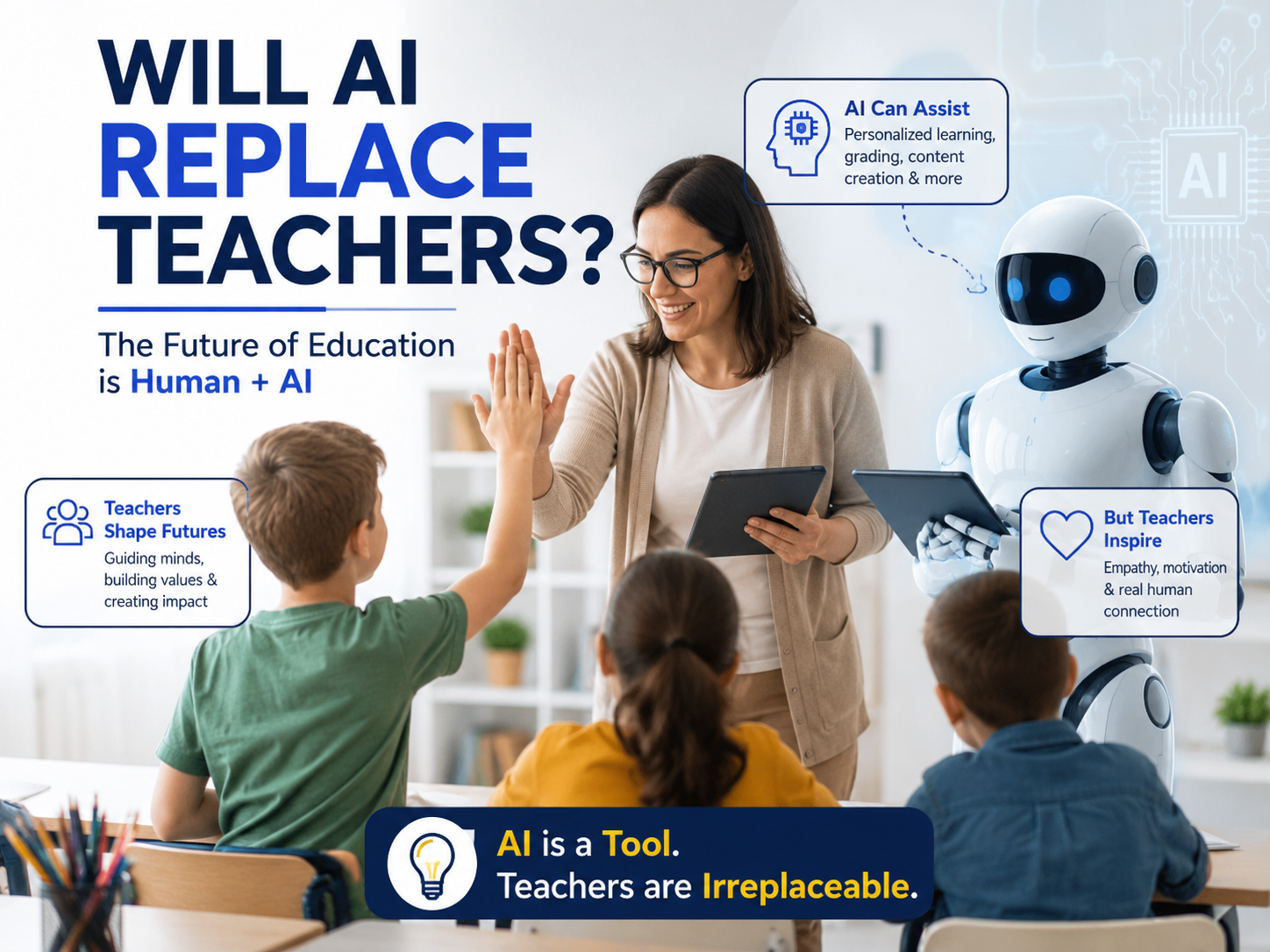
Every few months, a new headline asks the same unsettling question: will AI replace teachers? Parents worry about it. Teachers debate it in staff rooms. School administrators quietly wonder how it might reshape hiring in the next decade. And with tools like ChatGPT, Khanmigo, and countless AI tutoring apps now sitting in classrooms around the world, the question feels less like science fiction and more like an immediate, practical concern.
But the honest answer is more nuanced than a simple yes or no. AI is absolutely transforming education grading essays in seconds, generating lesson plans, personalizing practice problems, and even holding basic conversational tutoring sessions with students. At the same time, teaching has always been about far more than delivering information. It involves mentorship, emotional support, classroom management, and the kind of human judgment that no algorithm has fully replicated.
This article takes an honest, balanced look at where things actually stand: what AI in education is genuinely good at, where it falls short, what teacher jobs and AI really mean for the profession, and what the role of teachers in the AI era is likely to become.
Why the Question “Will AI Replace Teachers” Keeps Coming Up
The rise of generative AI has moved faster than almost any other technology in recent memory. Within a couple of years, AI tools went from novelty chatbots to genuinely useful teaching assistants capable of drafting rubrics, answering student questions, and adapting content to different reading levels.
This rapid progress naturally raises the question of whether AI could eventually do the whole job not just support teachers, but replace them outright. Several factors fuel this concern:
Read more: ai student data privacy
- School budgets are tight, and administrators are always looking for cost-effective solutions.
- AI tools are improving quickly and becoming cheaper to deploy at scale.
- Some ed-tech companies market their products as full replacements for one-on-one tutoring or even classroom instruction.
- Remote and hybrid learning during the pandemic normalized the idea of screen-based education.
Still, when you look closely at what actually happens in classrooms and what AI in education pros and cons really look like in practice the picture is far more collaborative than replacement-focused.
What AI Actually Does Well in Education
To understand the future of teaching with AI, it helps to separate what AI genuinely excels at from what gets exaggerated in marketing copy.
1. Personalized Practice and Pacing
AI-driven platforms can adjust the difficulty of practice problems in real time based on a student’s answers. A student struggling with fractions gets more scaffolded practice, while a student who’s mastered the concept moves on faster. This kind of micro-personalization is hard for a single teacher to deliver to 30 students simultaneously.
2. Administrative Relief
Grading multiple-choice quizzes, drafting first versions of lesson plans, generating differentiated worksheets, and summarizing long readings are all tasks AI handles efficiently. This frees up teacher time for the parts of the job that actually require a human.
3. On-Demand Tutoring Support
AI chatbots can answer a student’s question about a math problem at 9 p.m. when no teacher is available. This doesn’t replace instruction, but it fills gaps in access, particularly for students who don’t have tutors or engaged support at home.
4. Data-Driven Insights
AI can flag patterns of a student consistently missing questions on a specific topic, a class-wide dip in engagement that might take a teacher weeks to notice manually.
Where AI Falls Short: The Case for Human Teachers vs AI
Despite these strengths, there are core parts of teaching that AI simply cannot replicate, at least not with current technology. This is the heart of the human teachers vs AI debate.
1. Emotional and Social Development
Teaching isn’t just about content delivery. Teachers notice when a student is having a hard day, mediate conflicts between classmates, and build the kind of trust that encourages a shy student to speak up. AI can simulate empathy in text, but it cannot read a room, sense when a joke lands wrong, or build a multi-year relationship with a child as they grow.
Read more: brisk vs magicschool
2. Classroom Management
Anyone who has spent time in a room with 25 eight-year-olds knows that a huge part of teaching is behavioral redirecting attention, defusing conflict, and creating a safe, structured environment. This is deeply human work that requires split-second judgment calls AI cannot make from behind a screen.
3. Motivation and Mentorship
Students remember teachers who believed in them, pushed them past a plateau, or connected a subject to their personal interests. This kind of mentorship is relational, not transactional, and it’s one of the primary reasons students stay engaged in school at all.
4. Ethical and Contextual Judgment
Teachers make constant judgment calls about fairness, accommodations, and how to handle sensitive topics with different age groups. AI systems, trained on general patterns, often lack the contextual awareness to navigate these situations appropriately.
5. Equity Concerns
Not every student has reliable internet access or a device at home. Relying heavily on AI-driven instruction can widen existing gaps rather than close them, unless schools invest carefully in equitable access.
| Pros | Cons |
|---|---|
| Personalized practice and pacing | Cannot replace emotional connection |
| Saves teachers time on admin tasks | Risk of over-reliance and reduced critical thinking |
| 24/7 support for basic questions | Equity gaps for students without devices/internet |
| Quick identification of learning gaps | Struggles with nuanced classroom management |
| Scales tutoring support affordably | Data privacy and security concerns |
This balance sheet is why most education researchers and technologists agree that the future of teaching with AI looks like collaboration rather than replacement AI handling routine, scalable tasks, while teachers focus on the human, relational, and judgment-heavy parts of the job.
Teacher Jobs and AI: What the Data Actually Suggests
When people ask about teacher jobs and AI, they’re often really asking: will schools eventually need fewer teachers? Current evidence points away from mass job losses and toward a shift in what the job looks like.
- Job displacement is unlikely at scale. Teaching requires supervision, safety, and legal responsibility for minors roles that require certified, present adults regardless of how good the software gets.
- Job roles are shifting, not disappearing. Teachers increasingly act as facilitators who guide AI-assisted learning rather than sole content deliverers.
- New roles are emerging. Schools are hiring for positions like “AI integration coordinator” or “ed-tech specialist”jobs that didn’t exist five years ago.
- Teacher shortages remain a bigger issue than AI-driven layoffs. Many school districts are struggling to fill teaching positions at all, meaning AI is more likely to ease workload strain than eliminate jobs.
The Role of Teachers in the AI Era
So what does the role of teachers in the AI era actually look like going forward? A few clear patterns are emerging:
Emotional anchor. As AI takes over more routine instruction, the human relationship a teacher builds with students becomes even more valuable, not less.
- Critical thinking coach. With AI able to generate answers instantly, teachers are shifting focus toward teaching students how to evaluate, question, and use AI responsibly, a skill set often called AI literacy.
- Ethical gatekeeper. Teachers help students understand when AI use is appropriate (brainstorming, practice) versus when it undermines learning (outsourcing critical thinking entirely).
This evolution mirrors what happened with calculators and the internet: tools that initially sparked fears of replacing skills eventually became instruments that teachers learned to integrate thoughtfully into instruction.
So, Will AI Replace Teachers?
Bringing it all together: no, AI is not on track to replace teachers in any meaningful, wholesale sense. What it is doing is automating specific tasks: grading, content generation, basic tutoring while leaving the deeply human core of teaching intact and, arguably, more valuable than ever.
The schools and districts that will benefit most from AI are the ones that treat it as a tool for teachers rather than a substitute for them. The ones that struggle will likely be those that try to use AI as a cost-cutting shortcut without investing in the human support students genuinely need.
Final Thoughts
The future of teaching with AI isn’t a story of robots at the front of the classroom. It’s a story of teachers doing less repetitive administrative work and more of the mentorship, emotional support, and critical thinking coaching that only humans can provide. AI is a powerful assistant not a replacement and the schools that understand this distinction will be the ones that thrive in the years ahead.
If you’re an educator wondering how to start integrating AI into your own workflow without losing the human touch that makes teaching meaningful, the best approach is to start small: use AI for grading or lesson-plan drafts, and keep your energy focused on the relationships and judgment calls that define great teaching.
Read more: Diffit Review