Ask ten educators “is using AI cheating?” and you’ll get ten different answers. Some will say absolutely yes, no exceptions. Others will shrug and admit they use ChatGPT to write their own lesson plans. Somewhere between those two extremes sits the truth and it’s more nuanced than most viral headlines suggest.
If you’re a student wondering whether that AI-assisted essay crosses a line, or a teacher trying to figure out how to respond to a suspiciously polished submission, this guide is for you. Let’s unpack the real answer to the question “is using AI cheating?” without the panic, and without the denial.
Why This Question Is So Hard to Answer
The reason “is using AI cheating?”Consider these scenarios:
- A student asks ChatGPT to explain photosynthesis in simpler terms before writing their own summary.
- A student pastes the essay prompt into an AI tool, copies the output, and submits it as their own.
- A student writes a full draft, then asks AI to point out weak arguments.
- A student uses AI to fix grammar in an essay they wrote in a second language.
Most people would agree that scenario two is cheating. But scenarios one, three, and four? That’s where reasonable teachers, parents, and institutions genuinely disagree. The tool is the same the intent and the learning outcome are completely different.
Here’s a useful rule of thumb: cheating happens when you claim credit for thinking you didn’t do. AI doesn’t change that definition. It just makes the temptation more accessible.
What “Cheating” Has Always Meant
Academic dishonesty predates AI by centuries. Paying someone to write your paper, copying a friend’s homework, hiding notes in your sleeve these were all cheating long before students using ChatGPT became a headline. The core violation was never about the method. It was about misrepresentation: pretending work reflects your understanding when it doesn’t.
- That’s learning.
- Using AI to brainstorm angles for an essay you then write yourself? That’s a gray zone most modern policies now permit.
- Submitting AI-generated text as your original analysis? That’s misrepresentation and yes, that version of using AI is cheating in virtually every institution’s book.
The technology is new. The ethics are ancient.
The Reality of Students Using ChatGPT
Let’s be honest about the landscape. Surveys over the past few years consistently show that a large share of high school and university students have used AI tools for schoolwork and usage keeps climbing. Students using ChatGPT isn’t a fringe behavior anymore; it’s the norm.
But here’s the part that gets lost in the panic: most students aren’t using AI to fully outsource their work. Common uses include summarizing dense readings, generating practice questions, explaining math steps, improving grammar, and organizing outlines. These are the same things students once did with tutors, study groups, Grammarly, and CliffsNotes.
The problem isn’t that students are using AI. The problem is that many students genuinely don’t know where the line is because nobody has clearly drawn it for them. When a school stays silent on AI, students fill the silence with their own assumptions. That’s a policy failure, not just a student failure.
How to Detect AI Writing And Why It’s Harder Than You Think
Naturally, teachers want to know how to detect AI writing. There are some genuine tells:
- Uniform, “smooth” prose with no personality, risk, or awkwardness
- Generic examples that could apply to any essay on the topic
- Confident inaccuracies invented sources, fabricated quotes, wrong dates
- A sudden leap in quality compared to a student’s in-class writing
- Vague depth the essay says a lot without ever committing to a specific, personal argument
The most reliable signal isn’t in the text at all it’s in the gap between the submitted work and what the student can explain in conversation. A five-minute chat about their essay reveals more than any scanner. If a student can defend their thesis, explain why they chose a source, and rewrite a paragraph on the spot, the work is meaningfully theirs.
AI Detection Tools for Teachers: Useful, but Dangerously Imperfect
They promise a percentage score that tells you how likely a text is machine-generated. Tempting, right?
Here’s the uncomfortable truth: no AI detector is reliable enough to serve as sole evidence of misconduct.Studies have shown detectors disproportionately flag writing by non-native English speakers, whose simpler sentence structures resemble AI output. Students have been wrongly accused based on nothing but a detector score with real consequences for their records and mental health.
That doesn’t mean AI detection tools for teachers are useless. Used wisely, they’re a starting point for a conversation, not a verdict. A sensible workflow looks like this:
- Detector flags a submission.
- Teacher compares it against the student’s previous writing samples.
- Teacher invites the student to discuss the work not as an accusation, but as a check for understanding.
- Judgment is based on the full picture, never the score alone.
If you’re a teacher, treat a detection score the way a doctor treats a single lab result: informative, but never diagnostic on its own.
Academic Integrity and AI: Rewriting the Rules, Not Abandoning Them
Academic integrity and AI can absolutely coexist but only if institutions update their definitions. The old rulebooks were written for a world of plagiarism-by-copying. AI-generated text isn’t copied from anywhere; it’s statistically original, which is precisely why traditional plagiarism checkers miss it.
Forward-thinking schools are reframing academic integrity and AI around three principles:
Transparency. Students disclose when and how they used AI, the same way researchers disclose methods. “I used ChatGPT to outline this essay and check grammar” is honest. Silence is where dishonesty begins.
Attribution. If AI contributed ideas or text, that contribution is acknowledged just like citing a source or thanking an editor.
Demonstrated understanding. Assessment shifts toward what students can explain, defend, and apply, not just what they can submit. Oral defenses, in-class writing, and process portfolios make it much harder for AI use to mask a lack of learning.
Under this framework, the question “is using AI cheating?” gets a clean answer: it’s cheating when it’s hidden, unattributed, or used to fake understanding. It’s legitimate when it’s disclosed, permitted, and used to support learning.
Building an AI Policy for the Classroom That Actually Works
If you’re an educator, the single most effective thing you can do is publish a clear AI policy for the classroom before the first assignment, not after the first incident. A good AI policy for the classroom answers three questions students actually have:
1. What’s allowed? Be specific per assignment.”Use AI responsibly” is not.
2. What must be disclosed? Give students a simple disclosure format, like a one-line statement at the end of their work describing any AI assistance.
3. What happens if the rules are broken? Consequences should be proportional and educational first a redo with reflection often teaches more than a zero.
Some teachers use a traffic-light system: red assignments (no AI, done in class), yellow assignments (AI for support tasks only, with disclosure), and green assignments (AI collaboration encouraged, process documented). Students respond remarkably well to this clarity, because it replaces fear with rules they can actually follow.
Teaching AI Literacy: The Skill That Makes This Debate Obsolete
Here’s the long view: banning AI in education is like banning calculators in 1980 a battle that will be lost, and one that misses the point. The students in classrooms today will graduate into workplaces where AI fluency is assumed. Refusing to teach it doesn’t protect them; it disadvantages them.
That’s why teaching AI literacy matters more than policing AI use. AI literacy means students learn to:
- Prompt effectively and critically evaluate AI output
- Spot hallucinations, bias, and fabricated citations
- Understand what AI genuinely can’t do original judgment, lived experience, accountability
- Know when using AI helps them learn and when it robs them of the struggle that is the learning
A student with strong AI literacy doesn’t need to be told “is using AI cheating?Teaching AI literacy transforms the integrity conversation from a game of cat-and-mouse into a shared standard.
So, Is Using AI Cheating? The Final Verdict
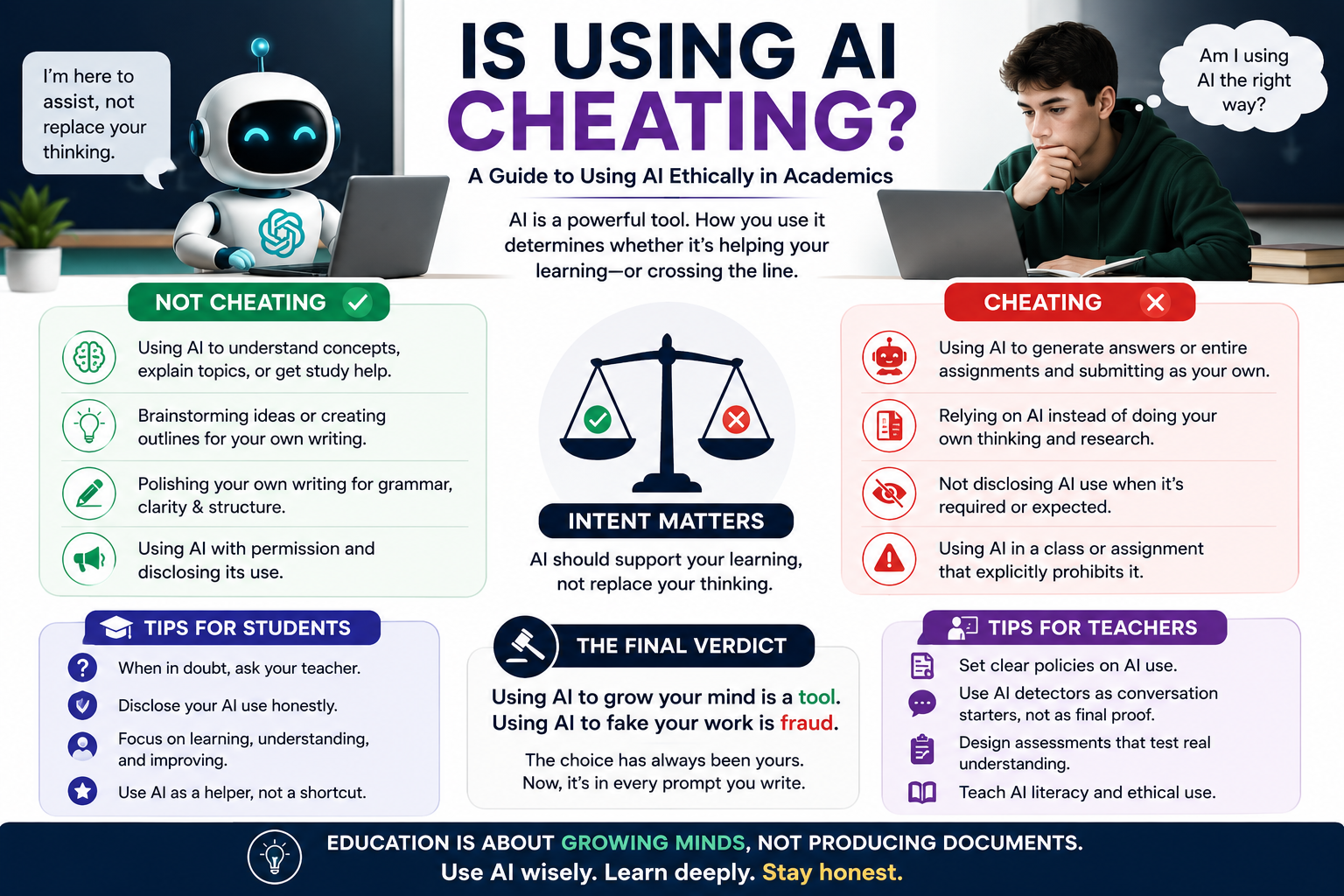
Let’s land the plane. Is using AI cheating? It depends entirely on how it’s used, whether it’s disclosed, and what the rules of the assignment are.
- Using AI to understand material, brainstorm, or polish your own writing with permission and disclosure is not cheating.
- Using AI to replace your thinking and submitting the output as your own that is cheating, full stop.
- Using AI in a class that explicitly prohibits it, even for “small” tasks that’s also a violation, because the rules define the game.
Honesty converts almost every gray area into safe territory.
For teachers: publish clear rules, use detectors as conversation starters rather than courtrooms, redesign assessments around demonstrated understanding, and invest in AI literacy.
The question “is using AI cheating?” will keep evolving as the technology does. But the principle underneath it never changes: education is about growing a mind, not producing a document. Any use of AI that grows the mind is a tool. Any use that fakes the growth is a fraud — no matter how impressive the output looks.
The choice, as it always has been, belongs to the person holding the pen. Or, these days, the prompt.